
POLICY BRIEF | November 2026
Prepared by: Kristy Smith, Director, Policy, Government Relations & Partnerships, Intellectual Property Ontario
Overview
Budget 2026 places significant emphasis on mobilizing private capital, improving Canada's competitiveness and ensuring Canadian businesses can commercialize and scale domestically. In the latest federal budget, intellectual property (IP) is increasingly positioned as an economic asset central to attracting investment and supporting commercialization.
Key IP relevant announcements in Federal Budget 2026
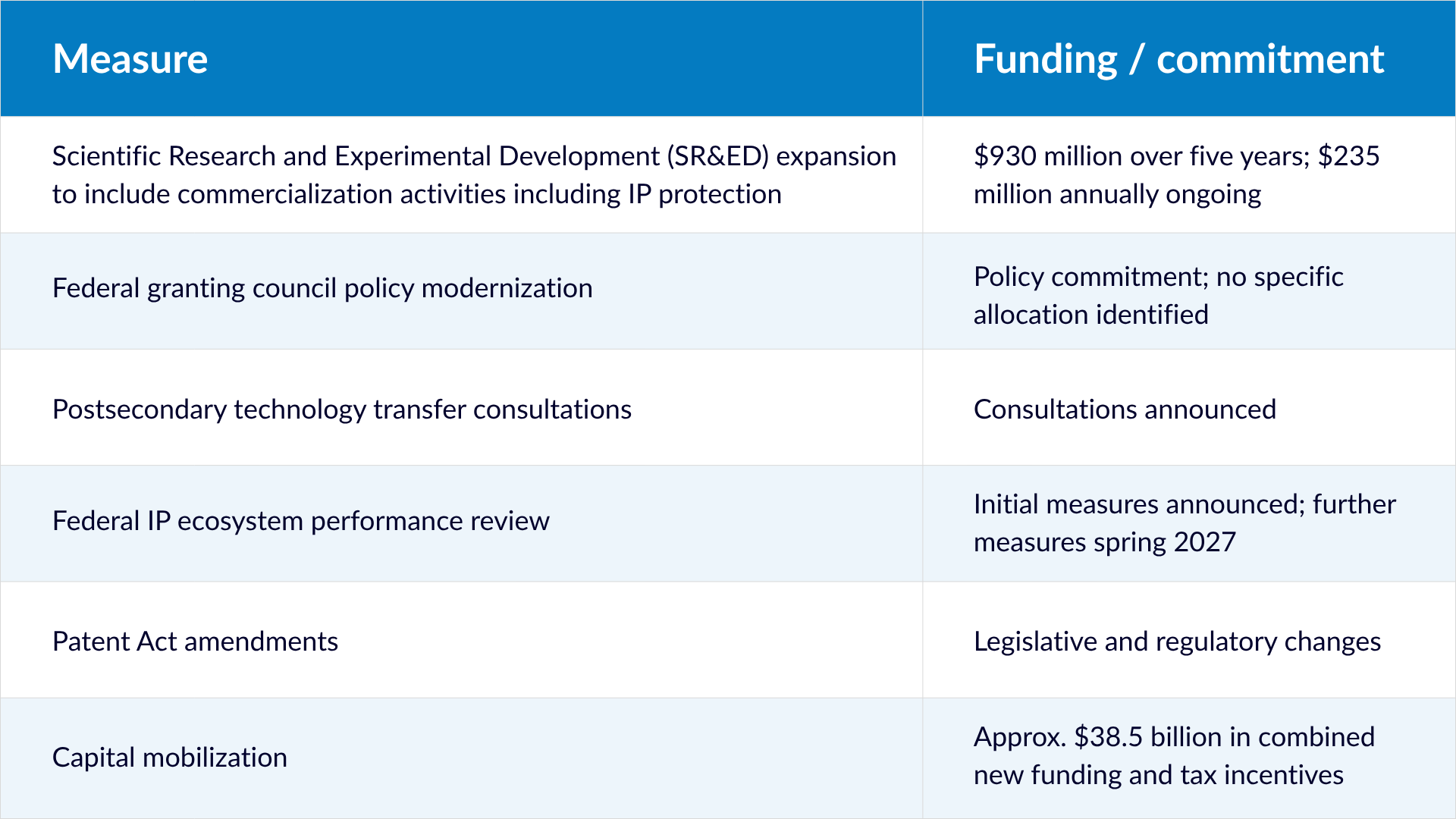
1. Intellectual property and commercialization measures
Significant expansion of SR&ED tax incentive including for IP protection
The budget proposes expanding SR&ED tax incentives ($930 million) to include certain commercialization expenditures, including securing and maintaining IP protection and obtaining regulatory approvals or certifications. The $930 million represents estimated tax support across both categories, not dedicated IP funding. Eligible expenses must be connected to qualifying SR&ED activities. Unlike IPON's direct funding and advisory services, assistance is delivered through tax credits to qualifying companies.
Budget reference: Chapter 1, S1.1, “Boosting innovation and commercialisation”; Tax Measures Annex, “Scientific Research and Experimental Development Tax Incentive Program.” Budget 2026.
Strengthening postsecondary commercialization
Budget 2026 commits to consulting experts on strengthening technology transfer capacity at Canadian postsecondary institutions. The government intends to modernize federal research granting council policies to improve commercialization outcomes and better leverage National Research Council IP. The consultations could lead to shared technology transfer services, although Technology Transfer Office (TTO) centralization models and timelines are not officially announced.
Budget reference: Chapter 1, S1.1, “Boosting innovation and commercialisation.” Budget 2026.
Patent modernization and federal IP review
Proposed Patent Act amendments would require registration of patent ownership transfers and establish minimum requirements for patent demand letters. These measures aim to increase transparency, reduce investor uncertainty and discourage abusive patent practices (such as patent trolls). Additional federal IP ecosystem measures are expected in spring 2027.
Budget reference: Chapter 1, S1.1, “Boosting innovation and commercialisation.” Budget 2026.
2. Capital mobilization: Keeping Canadian innovation and companies in Canada
A defining theme of Budget 2026 is addressing Canada's shortage of growth capital and creating conditions for Canadian companies to remain headquartered, undertake R&D and scale domestically rather than relocating to larger markets such as the United States.
Key measures:
$750 million Early and Growth Stage Investment Strategy: Previously announced BDC investments, including $75 million for pre-seed/seed financing and $675 million for later-stage growth capital.
$715 million Canada Growth Incentive: Estimated tax relief over four years through a new capital gains exemption and enhanced small-business rollover to encourage investment and reinvestment in Canadian companies.
$1 billion Strategic Response Fund: Proposed funding over six years beginning in 2028–29 for large-scale R&D and innovation projects.
Productivity Mega Deduction: Approximately $36 billion over five years in estimated tax relief to incentivize capital investment, including machinery, equipment and technology.
Budget reference: Chapter 1, S1.1, “Backing Canada's next generation of entrepreneurs,” “Helping Canadian innovators scale at home,” “Boosting innovation and commercialisation,” and “Kickstarting Canada's Investment Supercycle.” Budget 2026.
3. Summary
Budget 2026 demonstrates a positive evolution in federal innovation policy where IP is being treated not merely as a legal asset, but as a strategic economic lever for competitiveness, investment attraction and domestic wealth creation.
Measures supporting commercialization, technology transfer, firm growth and investment attraction reinforce the importance of a strong innovation ecosystem that helps firms move from research and development to commercialization and scale, while ensuring the value created through innovation is retained domestically. Together, these measures underscore a growing federal focus on translating Canadian innovation into economic outcomes and strengthening Canada's productivity and competitiveness.
More broadly, as governments invest heavily in capital mobilization, firm growth and sovereignty protectionism, investments in IP supports and services can help ensure these efforts translate into Canadian-owned intangible assets, stronger anchor companies and long-term economic benefits that remain in Ontario and Canada rather than being transferred abroad.